
What Is MRP? Understanding Material Requirements Planning Systems
If you run a manufacturing business, you know the juggling act: tracking raw materials, managing production schedules, keeping inventory lean, and shipping every order on time. For many small and medium enterprises across Southeast Asia, spreadsheets and manual processes are still the norm — and they are holding growth back. Material Requirements Planning (MRP) software was designed to solve this problem. It calculates what materials you need, when you need them, and how much to order. For manufacturers looking to scale without drowning in operational complexity, MRP is essential.
How MRP Systems Actually Work
At its core, MRP software answers three questions for every production run: What materials do I need? How many? And when?
It works backwards from customer orders or demand forecasts. The MRP system examines your Bill of Materials (BOM) — the complete recipe of components and raw materials for each finished product — then cross-references current inventory levels and supplier lead times. The result is a time-phased plan that tells procurement exactly when to order and the production floor when to begin each work order.
Why SMEs Need MRP More Than Ever
Large manufacturers have relied on MRP for decades, but the technology was historically priced beyond what smaller businesses could justify. Cloud-based platforms have changed that entirely. Today, SMEs can access the same planning intelligence as multinational corporations at a fraction of the cost.
The challenges SMEs face on the production floor are no simpler than those of larger competitors. Smaller teams mean fewer people to catch errors. Tighter cash flow means excess inventory ties up capital that could fuel growth. An MRP system addresses these pain points by automating calculations that would otherwise consume hours of manual planning each week.
Key Benefits of MRP Software for Manufacturers
- Smarter Inventory Control: MRP calculates precise material requirements so you carry just enough stock to meet demand. This reduces carrying costs, frees up warehouse space, and improves cash flow.
- Fewer Production Delays: By automatically flagging material shortages before they become emergencies, MRP gives your purchasing team time to source alternatives or adjust timelines. The result is smoother production runs with fewer costly stoppages.
- Accurate Demand Planning: Modern MRP systems use historical data and current orders to forecast production needs, preventing both overproduction (waste) and underproduction (missed sales).
- Stronger Supplier Relationships: Predictable ordering patterns earn you better pricing and priority fulfilment. MRP generates purchase orders aligned with actual production needs rather than reactive, last-minute requests.
- End-to-End Visibility: From raw material procurement through finished goods dispatch, MRP software provides a single source of truth. Managers can track work orders, monitor material consumption, and spot bottlenecks in real time.
MRP vs. ERP: Understanding the Difference
A common point of confusion is the relationship between MRP and ERP (Enterprise Resource Planning). Think of MRP as a focused tool for production and materials planning. ERP is the broader system connecting MRP with finance, sales, procurement, and warehousing.
The most effective approach for manufacturers is an ERP platform with a built-in MRP engine. This ensures a confirmed sales order automatically triggers production planning, which triggers purchasing — all within a single, connected workflow.
How SMURPS Brings MRP to Malaysian SMEs
For manufacturers in Malaysia and across Southeast Asia, SMURPS ERP offers a complete Manufacturing Management module with a fully integrated MRP engine built for SMEs. Unlike enterprise-grade systems requiring months of implementation, SMURPS is affordable, easy to deploy, and immediately practical.
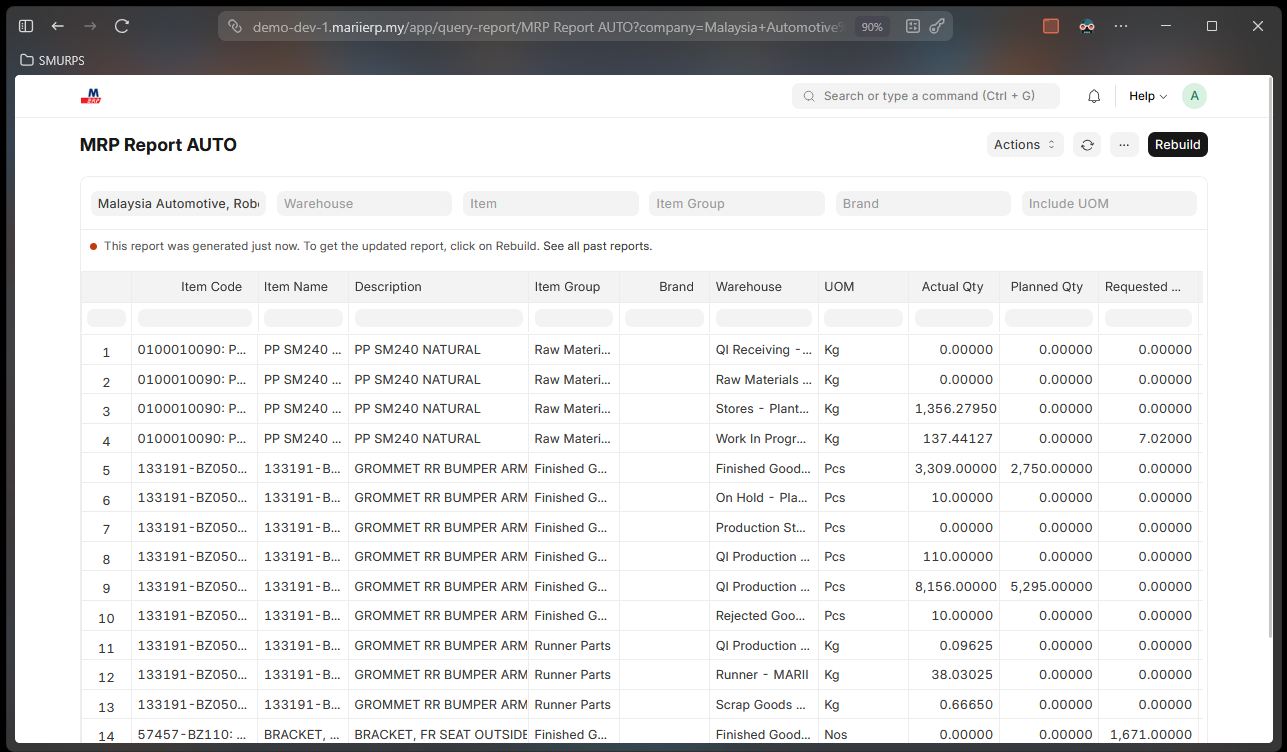
The SMURPS MRP engine supports multi-level BOM explosion, automatically breaking down complex product structures into every sub-assembly and raw component. It factors in on-hand stock, work-in-progress, reserved quantities, and incoming shipments to calculate true net requirements — where users then can generate purchase orders, material requests, and production work orders.
What sets SMURPS apart is that MRP does not operate in isolation. Production data flows into inventory, procurement, finance, and sales modules seamlessly. Pair that with SMURPS Analytics for real-time dashboards and SMURPS Autonobots for automating repetitive data entry, and every department stays aligned without extra overhead.
Getting Started with MRP Systems
If your manufacturing business still relies on spreadsheets, transitioning to MRP does not have to be overwhelming. Start by mapping your current Bill of Materials and identifying where material shortages occur most frequently. These pain points become your quickest wins once the system is live.
Choose a solution that integrates with the rest of your operations rather than one that creates another data silo. The goal is not just better material planning — it is a connected operation where sales, production, purchasing, and finance all work from the same real-time data.
Ready to see an MRP system in action? Visit smurps.com to book a free demo and discover how SMURPS ERP can transform your manufacturing operations from the ground up.